The Lancet has a new on-line birth/midwifery section with some interesting stuff on it:
http://www.thelancet.com/series/midwifery
This is the introduction to the series:
"The essential needs of childbearing women in all countries, and of their
babies and families, are the focus of this thought-provoking series of
international studies on midwifery. Many of those needs are still not
being met, decades after they have been recognized. New solutions are
required. The Series provides a framework for quality maternal and
newborn care (QMNC) that firmly places the needs of women and their
newborn infants at its centre. It is based on a definition of midwifery
that takes account of skills, attitudes and behaviours rather than
specific professional roles. The findings of this Series support a shift
from fragmented maternal and newborn care provision that is focussed on
identification and treatment of pathology to a whole-system approach
that provides skilled care for all."
The first editorial http://download.thelancet.com/flatcontentassets/series/midwifery/midwifery_exec_summ.pdf continues the theme of strengthening midwifery and placing of mother and baby at the centre of care and decision-making, and it also talks about relationships between health professionals and the women they care for. Lots of good articles, a welcome development given The Lancet's reputation and spread. The articles are free - simple to register and then download.
It is the appearance of this on The Lancet site that is such a welcome change. There is nothing particularly radical here in the content (good though it is), but it is good to see it coming from one of the intellectual bastions of western medicine.
Monday, 23 June 2014

Tuesday, 22 April 2014
"A canary in the coal mine: the growing popularity of unassisted childbirth" by Amy Wright Glenn
http://mobile.philly.com/blogs/?wss=%2Fphilly%2Fblogs%2Fbirth-breath-death%2F&id=255198201
A thoughtful on-line article summarising the freebirth situation in the USA.
I have been unable to track down the New Scientist article Amy Wright Glenn mentions but I did find this which is where I think the stats come from:
http://www.cdc.gov/mmwr/preview/mmwrhtml/00000345.htm
Also this article about a sect I had never heard of which describes more recent (2009) events in what I think is the same religious community:
http://www.religiondispatches.org/archive/sexandgender/1618/my_womb_for_his_purposes__the_perils_of_unassisted_childbirth_in_the_quiverfull_movement
and which shows that dogma, and especially patriarchal dogma, is not good for women.
A thoughtful on-line article summarising the freebirth situation in the USA.
I have been unable to track down the New Scientist article Amy Wright Glenn mentions but I did find this which is where I think the stats come from:
http://www.cdc.gov/mmwr/preview/mmwrhtml/00000345.htm
Also this article about a sect I had never heard of which describes more recent (2009) events in what I think is the same religious community:
http://www.religiondispatches.org/archive/sexandgender/1618/my_womb_for_his_purposes__the_perils_of_unassisted_childbirth_in_the_quiverfull_movement
and which shows that dogma, and especially patriarchal dogma, is not good for women.
Sunday, 23 March 2014
Freebirthing? - AIMS devotes its latest journal to Freebirth.
The Association for Improvements in Maternity Services (AIMS - see links to right) has devoted its latest journal (Vol 25, No 4) to Freebirth and an excellent volume it is too. Articles include why women choose freebirth, the concept of undisturbed birth, the "latent" stage of labour, the efficacy or otherwise of antenatal care, social services and freebirth, the legality of freebirth, and four in-depth accounts from women who have given free birth.
What struck me about the birth accounts was the slow, gentle, and undulating nature of undisturbed labour - the pattern of physiological labour written about here shows little in common with the regimes imposed by hospital policies and obstetric doctrine.
If you are considering freebirth or your friend, sister, daughter is doing so, then get hold of this journal and enjoy the read. It has a huge amount of information in its 28 pages.
To buy a copy, visit the AIMS site via the link on this page, go to the Journal page, find vol 25 no 4 and click on the "buy this journal" option, or find it on the publications order page.

What struck me about the birth accounts was the slow, gentle, and undulating nature of undisturbed labour - the pattern of physiological labour written about here shows little in common with the regimes imposed by hospital policies and obstetric doctrine.
If you are considering freebirth or your friend, sister, daughter is doing so, then get hold of this journal and enjoy the read. It has a huge amount of information in its 28 pages.
To buy a copy, visit the AIMS site via the link on this page, go to the Journal page, find vol 25 no 4 and click on the "buy this journal" option, or find it on the publications order page.
Sunday, 9 February 2014
WHICH? launches birth guide
WHICH? the consumer guide has launched an on-line guide to help women find out about birth choices locally that fit their preferences and choices. It is easy to use and, as it develops, should prove more and more helpful in informing women about what is on offer. UM played around with it and used the "compare" facility to view the "best fit" facilities. There was a surprising amount of information available, including guidelines and some birth statistics for all the units presented, and it is certainly a welcome and useful tool for gleaning information about which units locally are likely to suit you.
http://www.which.co.uk/birth-choice
It asks some basic questions about your preferences, where you live, age, parity etc and comes up with a list of choices for consideration. Top of my list came "Your Home" and there was plenty of information about homebirth as well as the other units around. All-in-all it presented me with the options I would have wanted and expected it to.
If you have any feedback on the site, you can contact BirthChoice on birthchoice@which.co.uk
http://www.which.co.uk/birth-choice
It asks some basic questions about your preferences, where you live, age, parity etc and comes up with a list of choices for consideration. Top of my list came "Your Home" and there was plenty of information about homebirth as well as the other units around. All-in-all it presented me with the options I would have wanted and expected it to.
If you have any feedback on the site, you can contact BirthChoice on birthchoice@which.co.uk
Friday, 31 January 2014
Article about Freebirth from USA
Here is quite a nice article telling the stories of a few clearly rational and sensible women:
http://www.mercurynews.com/health/ci_25012330/extreme-home-birthing-alone-and-unassisted
http://www.mercurynews.com/health/ci_25012330/extreme-home-birthing-alone-and-unassisted
Monday, 13 January 2014
Is Ultrasound Safe for Unborn Babies?
Well this issue continues to haunt us - the AIMS booklet Ultrasound Unsound www.aims.org.uk covers the main questions well and here is another, slightly more detailed discussion of the possible intracellular and intracellular dangers.
http://scienceoveracuppa.com/2013/01/10/the-biology-of-ultrasound/
It remains true that, given the absence of Randomised Controlled Trials with long-term follow-up, it is impossible to quantify the level of risk or the exact nature of that risk. However it also remains true that circumspection when it comes to the use of ultrasound on unborn babies is probably a wise approach.
http://scienceoveracuppa.com/2013/01/10/the-biology-of-ultrasound/
It remains true that, given the absence of Randomised Controlled Trials with long-term follow-up, it is impossible to quantify the level of risk or the exact nature of that risk. However it also remains true that circumspection when it comes to the use of ultrasound on unborn babies is probably a wise approach.
Saturday, 11 January 2014
An articulate comment on current maternity care.
http://www.bestdaily.co.uk/your-life/news/a543050/nhs-midwife-speaks-out-why-british-women-are-really-being-failed-in-birth.html
This is sad reading but a very well put and, I am sorry to say, an accurate portrayal of many obstetric units. I do believe that the culture of most birth centres and community midwifery services is less woman-unfriendly but the general point still pertains in that midwives working in those settings actively struggle against the attitudes and practices described. That struggle is part of their daily lives and also takes its toll.
We have placed human birth so far into a medico-legal paradigm that we have almost lost sight of the fact that it is a natural, social and sexual event at the heart of healthy family life. To heal this situation requires midwives and women to work together and for homebirth, community midwifery, doula, hypnobirthing, independent midwifery and birth centre services to be cherished and strengthened. Placing these services at the CENTRE of maternity care and not viewing them as frills is the way forward. Continuity of care and the relationship between midwife and mother is crucial to the humanisation of maternity care. How can such dismissive, unsupportive and demeaning attitudes and behaviours described in the article survive the building of proper relationships?
This is sad reading but a very well put and, I am sorry to say, an accurate portrayal of many obstetric units. I do believe that the culture of most birth centres and community midwifery services is less woman-unfriendly but the general point still pertains in that midwives working in those settings actively struggle against the attitudes and practices described. That struggle is part of their daily lives and also takes its toll.
We have placed human birth so far into a medico-legal paradigm that we have almost lost sight of the fact that it is a natural, social and sexual event at the heart of healthy family life. To heal this situation requires midwives and women to work together and for homebirth, community midwifery, doula, hypnobirthing, independent midwifery and birth centre services to be cherished and strengthened. Placing these services at the CENTRE of maternity care and not viewing them as frills is the way forward. Continuity of care and the relationship between midwife and mother is crucial to the humanisation of maternity care. How can such dismissive, unsupportive and demeaning attitudes and behaviours described in the article survive the building of proper relationships?
Thursday, 24 October 2013
Birth as we know it - a film about oxytocin
I have just watched a birth film that I love (although I loved the previous version called Birth into Being more). It is filmed mainly in Russia and what is so lovely about this film is you can almost see oxytocin, it is visible in the faces and expressions of the women filmed, it is almost palpable. I wish they would show this sort of film more on TV.
Oxytocin - the hormone that makes life possible, that makes us all tick, that makes the world go round, that mediates love and happiness - it really warrants a whole David Attenborough series, especially as other mammals show its importance too. Oxytocin is excreted by the posterior pituitary gland in situations of calm, joy, relaxation, love, sexual stimulation etc. But it almost seems to me that is is a physical outpouring of our soul life. It helps build the soul forces of our children too, in labour, at birth, and during breastfeeding.
For anyone who doubt the impact that good oxytocin secretion has, Birth As We Know It will soon put you right!!
Oxytocin - the hormone that makes life possible, that makes us all tick, that makes the world go round, that mediates love and happiness - it really warrants a whole David Attenborough series, especially as other mammals show its importance too. Oxytocin is excreted by the posterior pituitary gland in situations of calm, joy, relaxation, love, sexual stimulation etc. But it almost seems to me that is is a physical outpouring of our soul life. It helps build the soul forces of our children too, in labour, at birth, and during breastfeeding.
For anyone who doubt the impact that good oxytocin secretion has, Birth As We Know It will soon put you right!!
Tuesday, 22 October 2013
Birth furniture
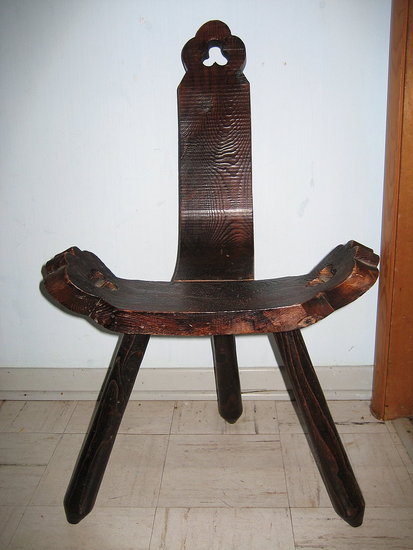 I have in my bedroom an old oak birth stool. I think it is early 20th century Spanish. It is basically three legs that bolt to a seat. The seat is narrow, curved and has hand grips, and there is a back-rest. It is a bit like this one (which is also Spanish) but is carved. The whole thing can be unbolted, tied together and left to sit in the back of a cupboard until needed. It is perfectly usable and simple.
There are a variety of birth stools, birth balls and birthing beds on the market. They must comply, of course, with "health and safety" requirements and are generally rather expensive. The NCT, for example, sells a fibre glass birth stool for £1,000 (not sure whether that says more about the stool or the NCT). However, most birth furniture is German and sells for German prices, and the UK seems not to either design or manufacture much decent birth furniture at all. The NCT birth stool for example is almost the only one readily available in the UK. But with 5,200,000 babies born annually in the EU, the market should surely be doing more?
Most birth beds are expensive, heavy, complicated and pretty uncomfortable, especially to sleep on. They are also quite hard to move around on and mobility is crucial in labour. Birth balls are popular because they are cheap (hence most maternity units have them and many people can afford one) and do a reasonable job especially in aiding pelvic movement. Most birth stools are pretty uncomfortable after any length of time and they can be hard to get down onto or up from. Few women want to spend much time on them and it is probably best if they don't, however great they can be for birth.
Enter the Osborne Chair!! This is a chair designed to aid mobility, be comfortable, be easy to get on and off, and comply with regulatory requirements. It particularly does what few other birth furniture does - cater for the need of labouring women to hang over things, to lean and kneel and rock and roll their pelvis. It is still in the development stage but looks good. Undercover Midwife looks forward to its launch and hopes it leads to the development of much more furniture designed for pregnancy, labour and breastfeeding.
http://www.birthupright.co.uk/
FOR AN UPDATE ON THE OSBORNE CHAIR, SEE MY POST OF OCTOBER 2017
Sunday, 15 September 2013
Good article in The Guardian about free-birth.
At last, a balanced presentation and discussion about free-birth in the mainstream media!
http://www.theguardian.com/lifeandstyle/2013/sep/14/freebirthing-birth-without-medical-support-safe
Lots of information and some useful links. Worth reading because it gives context to the free-birthing women's decisions and balances the autonomy-responsibility dyad well by not presenting them as conflicting as so many discussions do. Also covers many of the issues that need to be thought through when planning free-birth. Well done Joanna Moorehead.
http://www.theguardian.com/lifeandstyle/2013/sep/14/freebirthing-birth-without-medical-support-safe
Lots of information and some useful links. Worth reading because it gives context to the free-birthing women's decisions and balances the autonomy-responsibility dyad well by not presenting them as conflicting as so many discussions do. Also covers many of the issues that need to be thought through when planning free-birth. Well done Joanna Moorehead.
Subscribe to:
Posts (Atom)