Here is quite a nice article telling the stories of a few clearly rational and sensible women:
http://www.mercurynews.com/health/ci_25012330/extreme-home-birthing-alone-and-unassisted
Friday, 31 January 2014

Monday, 13 January 2014
Is Ultrasound Safe for Unborn Babies?
Well this issue continues to haunt us - the AIMS booklet Ultrasound Unsound www.aims.org.uk covers the main questions well and here is another, slightly more detailed discussion of the possible intracellular and intracellular dangers.
http://scienceoveracuppa.com/2013/01/10/the-biology-of-ultrasound/
It remains true that, given the absence of Randomised Controlled Trials with long-term follow-up, it is impossible to quantify the level of risk or the exact nature of that risk. However it also remains true that circumspection when it comes to the use of ultrasound on unborn babies is probably a wise approach.
http://scienceoveracuppa.com/2013/01/10/the-biology-of-ultrasound/
It remains true that, given the absence of Randomised Controlled Trials with long-term follow-up, it is impossible to quantify the level of risk or the exact nature of that risk. However it also remains true that circumspection when it comes to the use of ultrasound on unborn babies is probably a wise approach.
Saturday, 11 January 2014
An articulate comment on current maternity care.
http://www.bestdaily.co.uk/your-life/news/a543050/nhs-midwife-speaks-out-why-british-women-are-really-being-failed-in-birth.html
This is sad reading but a very well put and, I am sorry to say, an accurate portrayal of many obstetric units. I do believe that the culture of most birth centres and community midwifery services is less woman-unfriendly but the general point still pertains in that midwives working in those settings actively struggle against the attitudes and practices described. That struggle is part of their daily lives and also takes its toll.
We have placed human birth so far into a medico-legal paradigm that we have almost lost sight of the fact that it is a natural, social and sexual event at the heart of healthy family life. To heal this situation requires midwives and women to work together and for homebirth, community midwifery, doula, hypnobirthing, independent midwifery and birth centre services to be cherished and strengthened. Placing these services at the CENTRE of maternity care and not viewing them as frills is the way forward. Continuity of care and the relationship between midwife and mother is crucial to the humanisation of maternity care. How can such dismissive, unsupportive and demeaning attitudes and behaviours described in the article survive the building of proper relationships?
This is sad reading but a very well put and, I am sorry to say, an accurate portrayal of many obstetric units. I do believe that the culture of most birth centres and community midwifery services is less woman-unfriendly but the general point still pertains in that midwives working in those settings actively struggle against the attitudes and practices described. That struggle is part of their daily lives and also takes its toll.
We have placed human birth so far into a medico-legal paradigm that we have almost lost sight of the fact that it is a natural, social and sexual event at the heart of healthy family life. To heal this situation requires midwives and women to work together and for homebirth, community midwifery, doula, hypnobirthing, independent midwifery and birth centre services to be cherished and strengthened. Placing these services at the CENTRE of maternity care and not viewing them as frills is the way forward. Continuity of care and the relationship between midwife and mother is crucial to the humanisation of maternity care. How can such dismissive, unsupportive and demeaning attitudes and behaviours described in the article survive the building of proper relationships?
Thursday, 24 October 2013
Birth as we know it - a film about oxytocin
I have just watched a birth film that I love (although I loved the previous version called Birth into Being more). It is filmed mainly in Russia and what is so lovely about this film is you can almost see oxytocin, it is visible in the faces and expressions of the women filmed, it is almost palpable. I wish they would show this sort of film more on TV.
Oxytocin - the hormone that makes life possible, that makes us all tick, that makes the world go round, that mediates love and happiness - it really warrants a whole David Attenborough series, especially as other mammals show its importance too. Oxytocin is excreted by the posterior pituitary gland in situations of calm, joy, relaxation, love, sexual stimulation etc. But it almost seems to me that is is a physical outpouring of our soul life. It helps build the soul forces of our children too, in labour, at birth, and during breastfeeding.
For anyone who doubt the impact that good oxytocin secretion has, Birth As We Know It will soon put you right!!
Oxytocin - the hormone that makes life possible, that makes us all tick, that makes the world go round, that mediates love and happiness - it really warrants a whole David Attenborough series, especially as other mammals show its importance too. Oxytocin is excreted by the posterior pituitary gland in situations of calm, joy, relaxation, love, sexual stimulation etc. But it almost seems to me that is is a physical outpouring of our soul life. It helps build the soul forces of our children too, in labour, at birth, and during breastfeeding.
For anyone who doubt the impact that good oxytocin secretion has, Birth As We Know It will soon put you right!!
Tuesday, 22 October 2013
Birth furniture
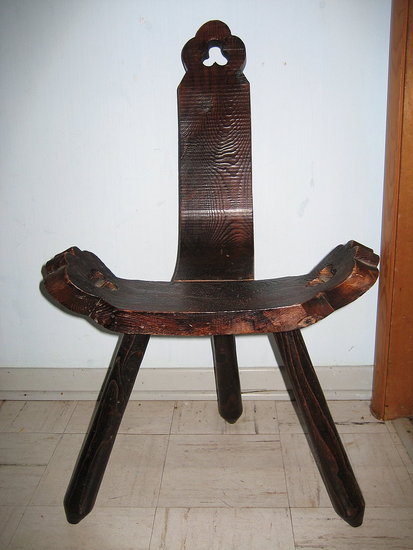 I have in my bedroom an old oak birth stool. I think it is early 20th century Spanish. It is basically three legs that bolt to a seat. The seat is narrow, curved and has hand grips, and there is a back-rest. It is a bit like this one (which is also Spanish) but is carved. The whole thing can be unbolted, tied together and left to sit in the back of a cupboard until needed. It is perfectly usable and simple.
There are a variety of birth stools, birth balls and birthing beds on the market. They must comply, of course, with "health and safety" requirements and are generally rather expensive. The NCT, for example, sells a fibre glass birth stool for £1,000 (not sure whether that says more about the stool or the NCT). However, most birth furniture is German and sells for German prices, and the UK seems not to either design or manufacture much decent birth furniture at all. The NCT birth stool for example is almost the only one readily available in the UK. But with 5,200,000 babies born annually in the EU, the market should surely be doing more?
Most birth beds are expensive, heavy, complicated and pretty uncomfortable, especially to sleep on. They are also quite hard to move around on and mobility is crucial in labour. Birth balls are popular because they are cheap (hence most maternity units have them and many people can afford one) and do a reasonable job especially in aiding pelvic movement. Most birth stools are pretty uncomfortable after any length of time and they can be hard to get down onto or up from. Few women want to spend much time on them and it is probably best if they don't, however great they can be for birth.
Enter the Osborne Chair!! This is a chair designed to aid mobility, be comfortable, be easy to get on and off, and comply with regulatory requirements. It particularly does what few other birth furniture does - cater for the need of labouring women to hang over things, to lean and kneel and rock and roll their pelvis. It is still in the development stage but looks good. Undercover Midwife looks forward to its launch and hopes it leads to the development of much more furniture designed for pregnancy, labour and breastfeeding.
http://www.birthupright.co.uk/
FOR AN UPDATE ON THE OSBORNE CHAIR, SEE MY POST OF OCTOBER 2017
Sunday, 15 September 2013
Good article in The Guardian about free-birth.
At last, a balanced presentation and discussion about free-birth in the mainstream media!
http://www.theguardian.com/lifeandstyle/2013/sep/14/freebirthing-birth-without-medical-support-safe
Lots of information and some useful links. Worth reading because it gives context to the free-birthing women's decisions and balances the autonomy-responsibility dyad well by not presenting them as conflicting as so many discussions do. Also covers many of the issues that need to be thought through when planning free-birth. Well done Joanna Moorehead.
http://www.theguardian.com/lifeandstyle/2013/sep/14/freebirthing-birth-without-medical-support-safe
Lots of information and some useful links. Worth reading because it gives context to the free-birthing women's decisions and balances the autonomy-responsibility dyad well by not presenting them as conflicting as so many discussions do. Also covers many of the issues that need to be thought through when planning free-birth. Well done Joanna Moorehead.
Tuesday, 20 August 2013
Facing Baby
Over the past 30 years there has been a sorry trend in baby carriers and especially prams whereby our babies are left without visual contact with their carers. This is the sort of thing I mean:


Where has this come from? Surely pram manufacturers are capable of making prams that enable inter-action with the baby as he or she grows? Slings that enable baby to face mummy or daddy are certainly available.
The second photo above was used to illustrate a story about Pullitzer prize-winning author Jared Diamond advising parents to boost their babies' confidence by carrying them facing outwards. Jared is an advocate of baby wearing which is great and points out that babies have been carried rather than pushed from time immemorial and that this is beneficial. My issue is where does this facing outwards idea then come from? Traditional societies cited by Diamond do not wear their babies facing outwards. To illustrate his point about traditional parenting wisdom, the article uses this picture:

Personally I have nothing against prams, especially as the baby grows heavier, though baby-wearing is wonderful. What concerns me is the relative isolation of the babies in the first two pictures compared with these:


and here:
http://www.literacytrust.org.uk/talk_to_your_baby/news/1553_do_baby_buggies_affect_development
As far as slings go, Elizabeth of Boba products (a baby sling maker) gives 9 good reasons why you shouldn't carry your baby facing outwards and here they are:
http://www.bobafamily.com/blog/2011/10/11/nine-reasons-not-to-carry-your-baby-facing-out/
Buying a pram, or even a good sling, is a costly business. They are important bits of kit, allowing us to get out and about, protecting baby from the elements, giving the opportunity for fresh air; but they are also about time spent together, introducing baby to the park, the shops, your locality and sharing your experience of those places with him or her. "Look, duck!", Look at the doggy run", "See the big red lorry", "Here's Grandma" and similar are ways of making sense of the world for the baby, of learning language and the association of word and object. They can't happen when you can't even see your child.

Wednesday, 10 July 2013
Undercover Midwife's Hats for Babies Campaign
Update!
The same advice albeit for different reasons goes for winter too. Here is a link to a simple autumn/winter bonnet that you may enjoy making for your little person.
http://www.ravelry.com/patterns/library/norwegian-sweet-baby-cap---djevellue
Thanks to Carol for supplying the e-address.
- - - - - - - - - - - - - - - - - - - - - - - - - - - - - - - - - - - - - - - - - - - - - - - - -
Oh dear, oh dear I am in moaning old bag mode here, be warned! My grouse is about the number of babies and toddlers who go hatless in hot weather.
Thin skulls, soft fontanelles, no or next-to-no hair and full hot sun shining on their little heads! Babies and toddlers who are not protected from the sun are at risk of sunstroke and that is a serious condition. A hat is an absolute must, no baby or toddler should be out in hot sun without head protection. Last week, hatless babies of just a few weeks old were being exposed to sun and temperatures in the high 20s almost everywhere I looked.
If you must take your baby out in the sun:
http://www.youtube.com/watch?v=qHIobBoFuKg
http://www.make-baby-stuff.com/baby-sun-hat.html
and a link to a good website with advice re sunstroke -
http://www.globalappointments.com/ARTICLES-JULY06/sunstroke-july06/Sunstroke.htm
No ifs, no buts, put a hat on your baby. And pass on the message!
The same advice albeit for different reasons goes for winter too. Here is a link to a simple autumn/winter bonnet that you may enjoy making for your little person.
http://www.ravelry.com/patterns/library/norwegian-sweet-baby-cap---djevellue
Thanks to Carol for supplying the e-address.
- - - - - - - - - - - - - - - - - - - - - - - - - - - - - - - - - - - - - - - - - - - - - - - - -
Oh dear, oh dear I am in moaning old bag mode here, be warned! My grouse is about the number of babies and toddlers who go hatless in hot weather.
Thin skulls, soft fontanelles, no or next-to-no hair and full hot sun shining on their little heads! Babies and toddlers who are not protected from the sun are at risk of sunstroke and that is a serious condition. A hat is an absolute must, no baby or toddler should be out in hot sun without head protection. Last week, hatless babies of just a few weeks old were being exposed to sun and temperatures in the high 20s almost everywhere I looked.
If you must take your baby out in the sun:
- Always have your baby shaded - you can use a sheet or wrap over her pram to protect her.
- Ensure that all exposed skin is covered, either by lightweight, loose-fitting clothing or with the shade cast by a wide brimmed hat or bonnet.
- Try to keep your baby in the shade when you take him outside.
- Check to make sure that your baby's staying cool during car rides.
- Give your baby more breastfeeds or fluids than usual on hot days.
- Protect the parts of your baby's skin that can't be covered with a suitable sunscreen (though it is best to protect using the steps above).
http://www.youtube.com/watch?v=qHIobBoFuKg
http://www.make-baby-stuff.com/baby-sun-hat.html
and a link to a good website with advice re sunstroke -
http://www.globalappointments.com/ARTICLES-JULY06/sunstroke-july06/Sunstroke.htm
No ifs, no buts, put a hat on your baby. And pass on the message!
Tuesday, 25 June 2013
Intermittent auscultation
Intermittent auscultation: the practice of listening to the baby's heartbeat at intervals either by a handheld ultrasonographic device (aka a Sonicaid) or a wooden or plastic fetal stethoscope known as a Pinard's stethoscope. Current NICE guidelines state that this should be done EVERY 15 MINUTES during established labour. The alternative is continuous monitoring of the baby's heart via a cardiotocograph (CTG machine).
A very interesting article by Ruth Martis in "Essentially MIDIRS" (Vol 4, no 5, May 2013) about the intrusiveness of intermittent auscultation and the lack of evidence regarding the efficacy of listening to baby's heartbeat in an otherwise normal labour/healthy woman. A woman quoted describes the experience of intermittent auscultation as being intermittently "ripped away from my peaceful place".
The level of evidence for NICE's 15 minute guideline is C, effectively nothing more than personal opinion. As obstetricians dominate the NICE maternity guidelines, this means obstetric opinion, and not scientific evidence. It is actually as near to continuously monitoring as they could get without actually opting for continuous monitoring by CTG machine, undoubtedly their favoured option if not for the presence of lay members and midwifery representatives pointing out that the evidence pointed against that. (Someone in the know told me this was the situation shortly after the intrapartum guideline was published.)
If some women (and of course many will want their midwife to listen to the baby's heart, whether at 15 minute or longer intervals) find it obtrusive, it also interferes with watchful midwifery. Having to fiddle around with a sonicaid or Pinard every 15 minutes, changing the woman's position to get a clear reading, interfering with clothing, having to talk to or touch her, as well as the noise of the sonicaid which is intrusive even at low volume. So called low-intervention care contains many interventions - pulse, blood pressure, palpations, FH auscultation, temperature-taking, asking questions, making records, noting times, offering drinks, massaging backs, even being in the same room ......they can all be intrusive and some women do not want or benefit from any of it. Especially those who are using hypnobirthing techniques or who are most emotionally and therefore physiologically comfortable in private peace and quiet, who need a deeply mammalian experience and environment. And there are far more women who need and want this than currently get it.
The Essentially MIDIRS article isn't available online but here is a link to Ruth Martis' proposal to undertake a review of auscultation and the frequency it may or may not be efficacious.
http://onlinelibrary.wiley.com/doi/10.1002/14651858.CD008680/full
and a link to her other work which includes the use of music during caesarean section:
http://scholar.google.com/citations?user=73RnpAEAAAAJ&hl=en
I am quite sure the questions Ruth is asking are important for women and midwives as she is asking questions about the nature of intervention itself in low-risk labour or where women do not want it regardless of risk. Undercover Midwife looks forward to reading more when she and her colleagues publish their review.
A very interesting article by Ruth Martis in "Essentially MIDIRS" (Vol 4, no 5, May 2013) about the intrusiveness of intermittent auscultation and the lack of evidence regarding the efficacy of listening to baby's heartbeat in an otherwise normal labour/healthy woman. A woman quoted describes the experience of intermittent auscultation as being intermittently "ripped away from my peaceful place".
The level of evidence for NICE's 15 minute guideline is C, effectively nothing more than personal opinion. As obstetricians dominate the NICE maternity guidelines, this means obstetric opinion, and not scientific evidence. It is actually as near to continuously monitoring as they could get without actually opting for continuous monitoring by CTG machine, undoubtedly their favoured option if not for the presence of lay members and midwifery representatives pointing out that the evidence pointed against that. (Someone in the know told me this was the situation shortly after the intrapartum guideline was published.)
If some women (and of course many will want their midwife to listen to the baby's heart, whether at 15 minute or longer intervals) find it obtrusive, it also interferes with watchful midwifery. Having to fiddle around with a sonicaid or Pinard every 15 minutes, changing the woman's position to get a clear reading, interfering with clothing, having to talk to or touch her, as well as the noise of the sonicaid which is intrusive even at low volume. So called low-intervention care contains many interventions - pulse, blood pressure, palpations, FH auscultation, temperature-taking, asking questions, making records, noting times, offering drinks, massaging backs, even being in the same room ......they can all be intrusive and some women do not want or benefit from any of it. Especially those who are using hypnobirthing techniques or who are most emotionally and therefore physiologically comfortable in private peace and quiet, who need a deeply mammalian experience and environment. And there are far more women who need and want this than currently get it.
The Essentially MIDIRS article isn't available online but here is a link to Ruth Martis' proposal to undertake a review of auscultation and the frequency it may or may not be efficacious.
http://onlinelibrary.wiley.com/doi/10.1002/14651858.CD008680/full
and a link to her other work which includes the use of music during caesarean section:
http://scholar.google.com/citations?user=73RnpAEAAAAJ&hl=en
I am quite sure the questions Ruth is asking are important for women and midwives as she is asking questions about the nature of intervention itself in low-risk labour or where women do not want it regardless of risk. Undercover Midwife looks forward to reading more when she and her colleagues publish their review.
Monday, 17 June 2013
Induction of labour and the risk of Caesarean section in low risk parous women.
A Swedish study has looked at the risk of CS in low risk PAROUS women who are induced (women who have had a baby before). The Caesarean section rate in this group is doubled following elective induction of labour and tripled if a cervical ripening method (eg Propess or prostaglandin gel) is used.
This research is very significant and urgently requires to be replicated to make sure its highly significant findings are confirmed in other settings. Any low-risk parous woman faced with elective induction should be made aware of the findings if she is to make an informed choice.
The paper can be found here:
http://www.ncbi.nlm.nih.gov/pubmed/23157554
This research is very significant and urgently requires to be replicated to make sure its highly significant findings are confirmed in other settings. Any low-risk parous woman faced with elective induction should be made aware of the findings if she is to make an informed choice.
The paper can be found here:
http://www.ncbi.nlm.nih.gov/pubmed/23157554
Subscribe to:
Posts (Atom)